- Published on
Darkmarket Trials: The Art of Fabricating Justifications and a Judicial Theater
- Authors

- Name
- Çağatay Evyapan - ChaO
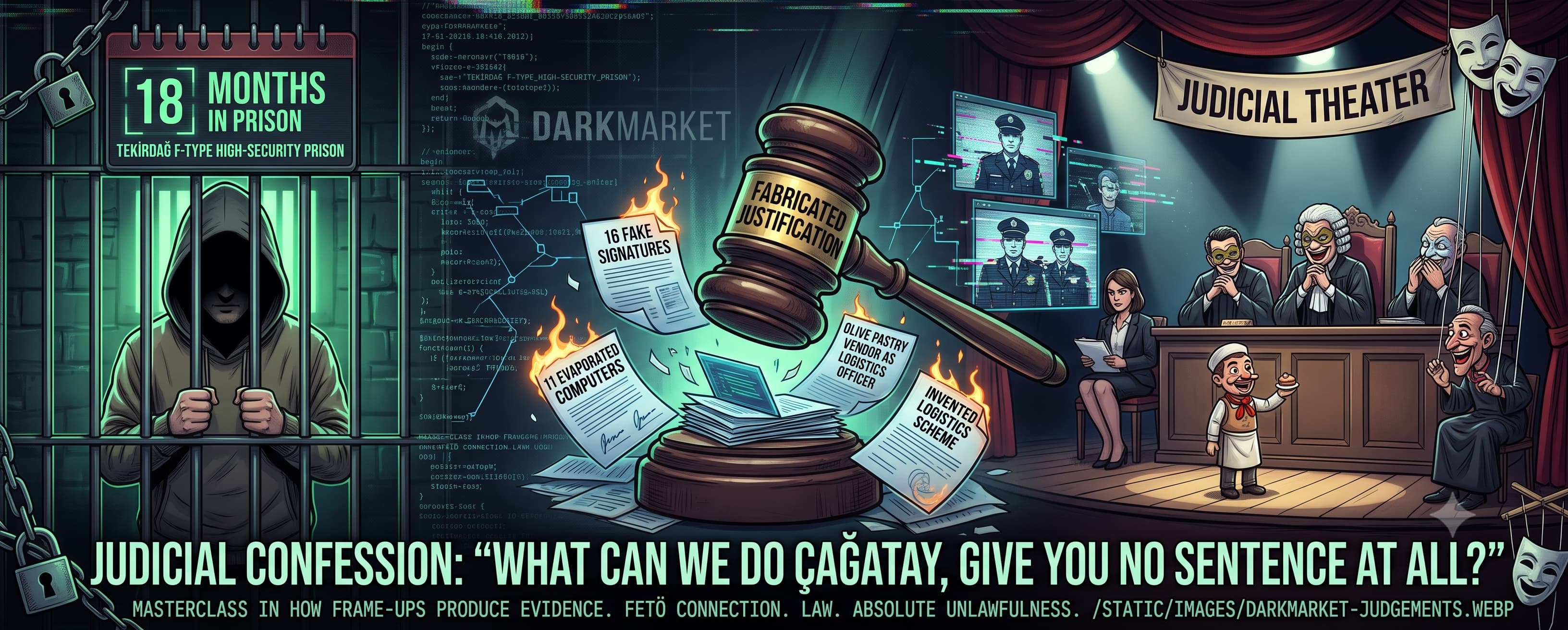
There are still people among book readers and academic researchers asking for the details of these trials. Writing about the "Darkmarket Turkey Trials" has been on my mind for a long time. Despite all the years that have passed, I am finally closing that chapter—one that ruined my mood whenever I recalled it and made me abandon several writing attempts halfway through. I worked hard on it, and perhaps it became a bit long. But when describing that court theater set up in this country not to establish justice, but to "find a pretext for the minaret no matter what," cutting it short would be an insult to the truth.
I. Wait 18 Months, Arrive in a Sweater, Present a Defense
Following our arrest, the confidentiality order on the case file lasted a full 12 months. For a whole year, we sat in prison without even knowing what we were accused of. It took another 6 months for the first trial to open. Easy to say; it was exactly 18 months after our arrest that we were able to appear before a judge for the first time.
At that time, I was in Tekirdağ No. 1 F-Type High-Security Prison. Normally, prisoners are taken by transfer vehicle at 06:00 in the morning to the Specially Authorized Heavy Penal Courts in Beşiktaş. Since I was to appear before the Kadıköy 1st Heavy Penal Court, I was to be transported alone, in a separate vehicle.
The evening before the trial, officers came: "Due to a shortage of gendarmerie personnel, you will not be taken to Istanbul tomorrow."
We accepted it; we would wait.
The next morning at 09:15. The door opened abruptly, a gendarme out of breath: "Come quickly, we are going to court, you got us into huge trouble!"
They didn't even give me the chance to put on a suit. I was hurriedly put into a special transfer vehicle wearing a casual sweater. Sirens blared, we sped down the emergency lane and barely made it to the 10:30 hearing.
"What did I do this time to get you into trouble?" I asked.
It turned out that when the prison administration called the court clerk at 09:00 to report that I couldn't come, a judge on the panel roared: "If Çağatay is not here on time, we will immediately take necessary legal action against you!" The gendarmerie was right, I really had gotten them into trouble. But the state, which said "we aren't taking you" the night before, was saying "come urgently" in the morning.
The courtroom was like Doomsday. Defendants, lawyers, relatives, journalists... When I arrived, the hearing had already started, identity checks and legal routines were entered into the record. Everyone was dressed in sharp suits. As for me, in my shabby sweater, I took my place in the middle of those bewildered glances.
II. The Indictment's Confession: "No Evidence, But an Organization Exists"
Since I was tried as the leader of the organization, I was given the first right of defense. I stepped up to the podium. Just as I was about to start, I got stuck on that absurd sentence in the very first paragraph of the indictment. I read it word for word:
"...Despite all technical and physical surveillance efforts, it was not possible to enter the website named Darkmarket, set up and operated by Defendant Çağatay Evyapan, or to collect information and evidence..."
Wait a minute. In the introduction of the indictment, you personally confess that you could not enter the site and could not collect evidence. So what did you write an indictment for then? Details like needing three guarantors to join Darkmarket have already been covered in books; we know them. But since you have no evidence in hand, on what basis are you conducting this trial?
Anyway, I returned to my defense in my sweater. I explained that I was brought in haste, could not get my written defense, and couldn't even change my clothes. I requested a session's postponement for my defense. But I added:
"In this case, there are people who have been unjustly jailed for 18 months, accused of being members of the organization I allegedly founded. If I don't testify, you won't even evaluate their detention status. Therefore, if you permit, let me make an oral defense limited strictly to the charge of 'establishing and managing an organization.'"
The judges smiled and agreed.
I began to explain: "One of the detainees here is a teacher affiliated with the Ministry of Education. Another is a tradesman of 30 years in the industrial estate. These people don't even know my name. KOM Cyber Crimes Branch could not find a third person alongside Hakkan and me to fit this case into 'organized crime.' Out of necessity, they presented these people as organization members using codenames and deceived you."
The presiding judge sharply interrupted: "In short, what are you saying Çağatay, do these men have anything to do with the crime or not?"
"No, they don't. All of them are victims."
At the end of that hearing, all detained defendants except Hakkan and me were released. With our sweater, we had at least been of some use.
III. Absolute Unlawfulness: Why Track a Fugitive?
I went to the next hearing calmly, having prepared my entire statement in writing. I had experienced many times that words were incompletely or incorrectly recorded in the transcripts; I had to cover my bases.
Now let me tell you about the main scandal. According to the file, surveillance decisions against me had started in April 2008, 4–5 months before my arrest. Yet in reality, they had been after me since July 2007. They had placed hidden wiretaps in my home; I caught them and recorded them on video. Then they rented the villa opposite mine and lived in the same gated community with me for more than a year.
But the issue isn't the length of time. The issue is this: There is a flawless case of Absolute Unlawfulness.
Why? Because at that time, I was a fugitive convict who had received the maximum sentence under the Turkish Penal Code, wanted with a "shoot if he ignores the stop order" warrant. The law is crystal clear: A public official who sees me and fails to arrest me is dismissed from the profession and faces imprisonment. In fact, the law states: "If the person committing this is the officer tasked with apprehending the suspect, the penalty shall be applied at the maximum limit."
In other words, the law tells the police: "The moment you see this man, handcuff him and bring him in."
So what did the officers tasked with capturing me do? On one hand, they went to my legal address and filed a false report stating "Çağatay could not be found here." On the other hand, they tricked the courts by saying "There is an informant report, we are searching for evidence," obtaining physical surveillance decisions for months. The man is a fugitive. Instead of arresting him, you rent villas and track him, lie to the court, and conduct illegal wiretaps. All of these were blatant crimes, and the evidence was right inside the case file itself.
Stolen Computers and a 16-Page Fabricated Protocol
In the raid videos they leaked to the press, it is clearly seen that there were 13 computers in my house. But they handed over only 2 to justice. 11 of my computers evaporated. Why? Because inside them were camera recordings of my house and recordings of my conversations with the police officers who set up the frame-up. If they had delivered those computers to the judiciary, they couldn't have pulled off this scheme.
Now let's come to the backbone of the case. Raids had been conducted on over 50 addresses in the case, and on all search protocols, the signatures of two "attending witnesses" (hazirun) consisting of neighbors were complete.
So what was the search protocol at the home of Defendant No. 1—me—like?
A 16-page computer printout. Not a single attending witness signature on it. Yet my home was in a military area; even my officer neighbors who heard the news had come, but the police drove them all away. To make it even funnier, on each of the 16 pages, there were a total of 16 signatures claimed to belong to me. All of them were fake. Not a single protocol had been drawn up at my home, and I hadn't signed a single paper.
I dropped the bomb in court: "Take my handwriting samples. Send them to forensics. If even a single one of those 16 signatures turns out to be mine, I forfeit all my rights of defense and accept all charges!"
The protocol was so fake that it screamed "I am a fabrication." Under the law, evidence obtained in a search without attending witnesses is invalid. Knowing this, the police panicked and stamped the signatures of almost everyone at KOM Cyber Crimes Branch at the bottom of the protocol. On a document normally signed by 2–3 officers, there were two dozen names. They probably thought, "The more signatures, the more real it looks."
After explaining all this, I asked: "If your goal was to throw me in prison, I am already a fugitive, my sentences are finalized, my execution terms are set. No matter what I am charged with in this file, I won't serve a single extra day. I don't need to lie. But as public officials deriving authority from the law, why did you feel the need to deceive your superiors, the prosecutor's office, and the court with an organized lie? What were you waiting for?"
I requested the dismissal of the case due to Absolute Unlawfulness. I spoke for perhaps 4 hours. Not a peep in the hall. They didn't interrupt me even once.
IV. Olive Pastry: Logistics Officer of the Syndicate
I cannot pass without describing the most Kafkaesque scene of this judicial theater: declaring a pastry vendor the "logistics officer of an international cybercrime organization"...
Here is what happened:
I am talking to Hakkan on the phone. "On your way to my place, drop by the pastry vendor and pick up my package," I say. Then I add: "Make sure you don't forget my package."
That's all. Two sentences.
What is the package I am talking about? Olive pastry. The olive roll I ate every morning, ordered from the vendor.
How did KOM Cyber Crimes Branch interpret this conversation? The street pastry vendor was declared the logistics officer of our organization! Supposedly we were speaking in code ("package"). Supposedly, if it weren't crucial, I wouldn't have insisted twice. That man was allegedly carrying internal organizational hardware!
They went and caught the man. They tried him. And they gave him a prison sentence.
A street vendor opening his stall at eight in the morning was convicted as a "logistics officer" in the international Darkmarket cartel simply because he sold olive pastries.
V. Curtains of the Theater
"What Are You Staring At, Dickhead?!"
Taking my defense into consideration, the court issued a decision for "Expansion of Investigation" (Tevsii Tahkikat) and requested raw footage of the operation from the police department. It also summoned all personnel of KOM Cyber Crimes Branch to the hearing. We were excited; facing Simon1 and Simon2 in court and listening to their lies under oath was going to be entertaining.
On the day of the hearing, as I entered the room under high security surrounded by a gendarmerie ring, I locked eyes at the door with a long-haired inspector. With that swagger born of tension, he shouted: — "What are you staring at, dickhead?!" — "Can't help myself when I see an asshole, what can I do, dickhead?!"
The entire hall, including the panel of judges, turned toward us. Amidst those laughing while looking at the bright red inspector and me, we started the hearing.
Projector Disaster and the Mysterious Woman
The footage had arrived, but as I guessed, it wasn't raw—it was in edited clip form. There wasn't a single frame showing a protocol being drawn up. The court decided to watch the footage via a projector. However, the computer didn't work. They said it was a codec issue. "We'll fix it by the next session," they said.
KOM officers took the stand one by one and were sworn in. Of course, Simon1 and Simon2 were nowhere to be found. They hadn't paid any attention to the court. Do you know what the inspector who yelled "What are you staring at, dickhead" said when he stepped up to the podium? He was the officer in charge of the file, but he had been assigned to the branch on the exact day of the operation! He claimed he didn't know anything prior. In the world's largest cyber operation, the inspector carrying the folders knew nothing. The actual conspirators hadn't even signed the file.
What do you think happened at the next hearing? The court computer set up by the IT technicians didn't work again! Pure coincidence.
But the real oddity that day was something else. A female judge whom we had never seen before had joined the trial panel. She was constantly showing small notes in her hand to other members, even to the prosecutor, whispering as if giving instructions. When the computer failed again, we were taken outside for the interlocutory decision. I asked my lawyer: "Who is this woman?"
When the interlocutory decision was announced, I lost it. The court had canceled all previous decisions regarding examination and expanding the investigation. They had abandoned watching the footage and taking my handwriting samples. Moreover, they had done this without asking us.
Then we learned who that woman was.
She was the wife of our investigating prosecutor—the one who prepared our file and stood at attention next to Simon1! Coincidentally assigned to our panel that day, with papers in her hand containing cooking recipes, she was redirecting the course of the case crafted by her husband.
An incident that would look ridiculous if written in a fiction novel was taking place in a Turkish courtroom.
VI. The Court of Cassation and the Art of Fabricating Justifications
The court of first instance delivered its verdict: Everyone from the painter to the pastry vendor received 2 years for being an organization member, plus an extra 7.5 years for Hakkan because his offense was deemed organizational. And a sentence for me for leadership. Yet in reality, there was only a single concrete crime committed by Hakkan.
The file went to the Court of Cassation, and 2 years later the decision came: There is no organization. The pastry vendor was acquitted. The painter was acquitted. Everyone was acquitted. My sentence and Hakkan's sentence were also overturned, and we appeared before the court again. If there was no organization, I couldn't be tried for leadership. There was no link left to tie Hakkan's crime to me.
The new panel began reading its decision:
"...That Hakkan and Çağatay, wearing technical service uniforms, jointly installed a skimmer on the ATM and cloned cards..."
I leaped to my feet. In not a single page of the file, in not a single police report was there such a claim! Neither the conspirators nor the prosecutor had ever made such an accusation!
"You are literally fabricating justifications!" I shouted. "Either don't rule with this made-up justification, or process charges against me for slander and insulting the court!"
There was a brief silence. The presiding judge turned to me and uttered that historic sentence:
"What can we do Çağatay, give you no sentence at all?"
I sat back down. "I won't stand up again," I said.
Epilogue: Two Sentences
When the judge uttered that sentence, I sat down and waited silently for the verdict to be dictated.
At that moment, there was a truth that the robed figures in the room, the scheming police officers, and that dark structure failed to realize: The sentence they gave me had not a single second that could be added to the time I was already serving. I was already a fugitive who had received the heaviest penalties prescribed by law. A new conviction held zero sway over my execution term. They knew it, and so did I.
All those false protocols, stolen computers, the panel featuring the prosecutor's wife, the indictment making the pastry vendor an organization chief... All of it was for a grand total of nothing. They committed all these crimes just to fabricate a justification, to write a "success" on paper.
Ridiculous.
But when I sat in that chair, I cared about none of it. My time had stopped long before, on September 4, 2008, at 09:34 AM.
That phone call. That voice. "Gülce... yesterday... committed suicide."
The world stopped that second and never turned again. The courtroom, prison walls, bars... All erased. Because the real dungeon had long been built inside me.
When Gülce rejected this world and withdrew into that absolute nothingness, that Great Silence, the end of our two-person tragedy was written as well. She chose death. As for me, I chose the guard duty over that vast silence she left behind.
The verdict of that fake sentence handed down by the FETÖ frame-up in the courtroom was zero. But the sentence I imposed on myself—hearing that phone call again every morning, carrying the absence of that woman whose real name I couldn't even speak like a shackle in every breath... Its term is for life.
The decision they invented was upheld by the Court of Cassation and filed away in dusty archives. My sentence, however, is being executed every day, every hour. And it will be executed until the last day.
And what happened to those who built that theater? After July 15, they all scattered. It turned out that those cadres in the KOM Cyber Crimes Branch were FETÖ members. Bilal Şen, the "hero" chief of the operation, went to prison as a terrorist. Simon1 was marked "dead" in state records, evaporated, and fled. Simon2 quietly retired and vanished into thin air. Some in prison, some fugitives, some in the grave.
Today, legal scholars call that file a "Masterclass in How Frame-ups Produce Evidence." I will request a retrial. Frame-up is using the authority of the law for unlawfulness. And this frame-up was confessed by a judge's own mouth with this sentence:
"What can we do Çağatay, give you no sentence at all?"
You gave it. But it didn't turn out the way you thought. The term of that sentence on paper you gave has long expired.
My real sentence, however, continues.
Paylaş: