- Published on
A Conspiracy Laboratory: The KOM Cyber Crimes Branch
- Authors

- Name
- Çağatay Evyapan - ChaO
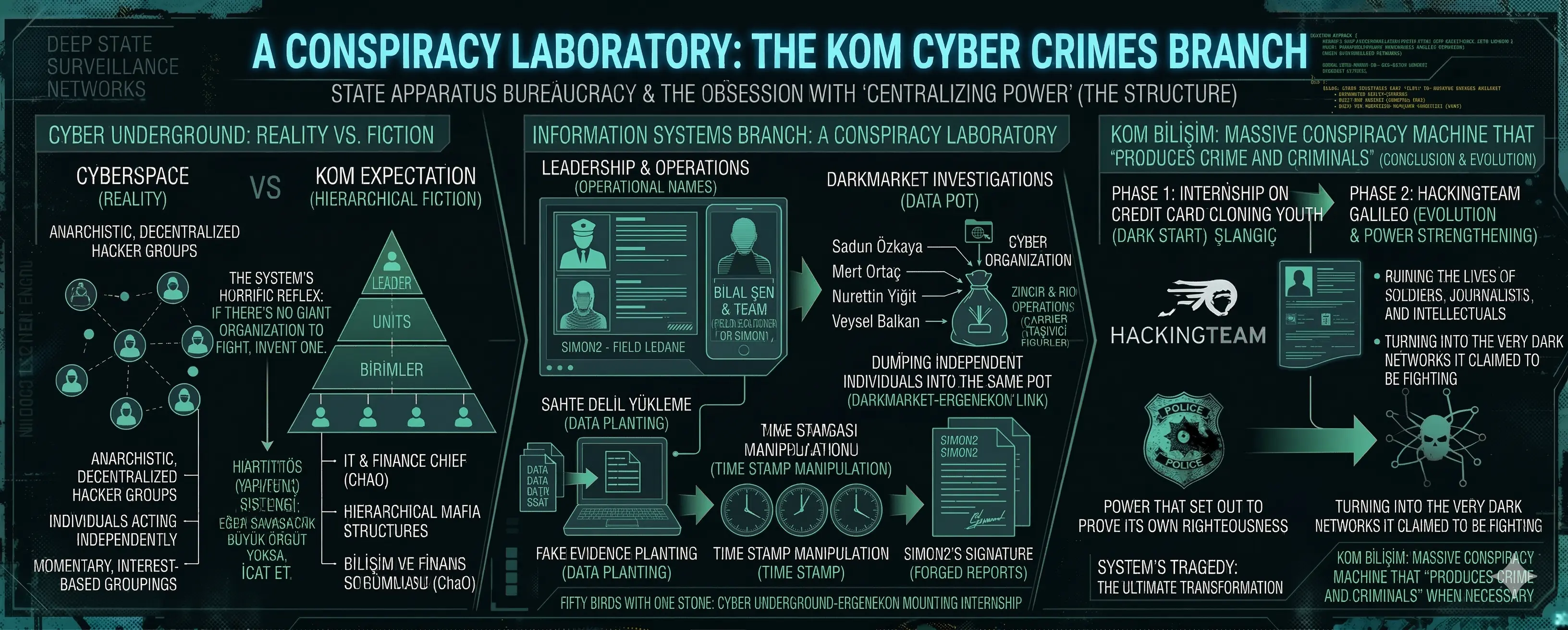
The state apparatus is by nature a bureaucratic machine, and every unit within it needs tangible successes to sustain its existence, receive budgets, and prove its power. However, in the early 2000s, the digitalization of crime suddenly rendered the state’s conventional security reflexes obsolete. Classic wiretapping, physical surveillance, and street intelligence were helpless against the anarchic, borderless structure of cyberspace. At this point, the idea emerged to establish a civilian or technically weighted independent unit within the state to combat cybercrime. Yet, the structure aiming to infiltrate the state’s capillaries and obsessed with centralizing power (known today as FETÖ) fiercely opposed this. For them, the Smuggling and Organized Crime (KOM) departments were untouchable headquarters; they would never allow this new, immense power brought by the digital world to slip outside their own command center.
As a result of this ambition, the "Information Systems Branch" was directly mounted into the heart of KOM—the most heavy-handed and operational apparatus of the police force. Led by Bilal Şen and his team, this new branch was ostensibly to fight cybercrime. However, before long, the ruthless rule of bureaucracy kicked in: a unit that receives massive budgets, is equipped with state-of-the-art technology, and chases "organized crime" like KOM needed massive organized crime syndicates to justify its existence.
But there was a structural problem. The cyber underground did not resemble the hierarchical mafia structures KOM was accustomed to. Hackers were generally anarchistic, decentralized individuals acting independently, coming together and dispersing momentarily around shared interests. There was no "cyber cartel" with a leader, an organizational chart, and a chain of command that KOM could dismantle with massive operations. At this very point, the system resorted to a horrific reflex: if there was no giant organization to fight, they had to invent that organization to prove their necessity.
The greatest laboratory of this invention process was the massive web built over independent cybercriminals in Turkey under the pretext of the DarkMarket investigations. The goal was to unite dozens of individuals, who were independently cloning credit cards or infiltrating systems, under a single chart. From Sadun Özkaya to Mert Ortaç, from Nurettin Yiğit to Veysel Balkan, from the Zincir Operations in Antalya to the Rio Operations, all figures who had no organic connection under normal circumstances were dumped into the same pot as members of a so-called "international cyber organization." The ultimate goal of the conspiracy was much larger: to link this fictitious cyber army to the Ergenekon case and place ChaO at the very top as the "IT and finance chief" of this structure. The setups described in detail in books and the complex traps built through pawns were actually desperate moves designed to pull ChaO into the center of this scenario.
So, how was it legally possible to place so many people, completely unaware of each other, under technical and physical surveillance for months within the scope of the same organization file?
This is where the dark paperwork bureaucracy of KOM Bilişim and Simon2, the field executioner for Simon1, stepped in. To get this non-existent organizational chart accepted by the courts, fabricated informant reports were invented to bypass the law. Almost all of these reports, either anonymous or forged, bore the signature of Simon2. Fake evidence was remotely planted on the targets' computers, time stamps were manipulated, and an ordinary IT crime was transformed on paper into part of an international terror and finance network. Planning to kill fifty birds with one stone, this structure was performing a perfect "internship" by mounting Turkey’s cyber underground into one of the largest political cases in history (Ergenekon) just to prove its own validity.
In conclusion, KOM Bilişim went down in history not as a security unit that catches criminals, but as a massive conspiracy machine that "produces crime and criminals" when necessary. This dark internship, which began by planting fake digital evidence on the computers of youths cloning credit cards, eventually evolved—combined with spyware (Galileo) purchased from HackingTeam—into the backbone of those grand conspiracies that ruined the lives of soldiers, journalists, and intellectuals in later years.
This was the greatest tragedy of the system: a power that set out to prove its own righteousness ultimately turned into the very dark networks it claimed to be fighting.
Paylaş: