- Published on
The God Mode Obsession: Besieging a State with Code
- Authors

- Name
- Çağatay Evyapan - ChaO
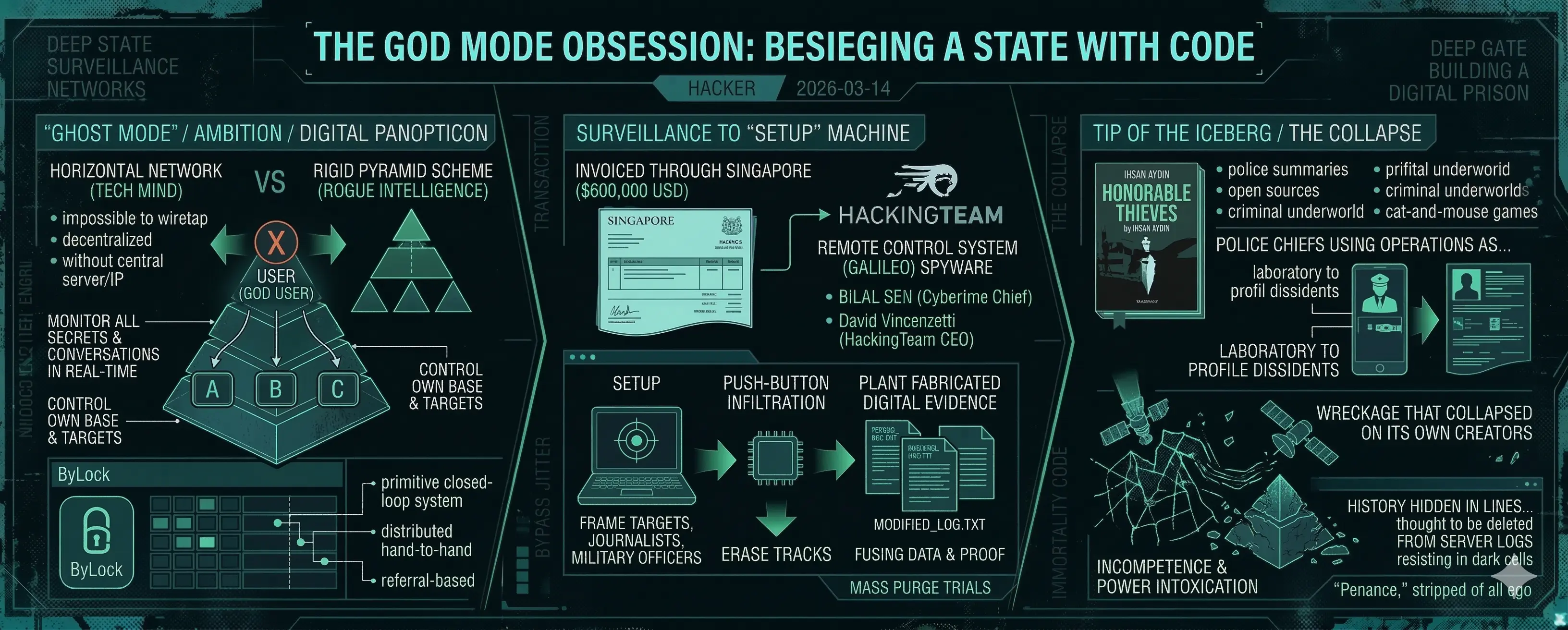
The early days of the internet were a period of romantic anarchy where borders vanished, and the sluggish structures of states were left helpless against digital velocity. However, this illusion of freedom did not last long. States, and the dark factions that infiltrated them, never forgive the invisible or the uncontrollable. The events that unfolded in the Turkish underground, police corridors, and the dark alleys of cyberspace since the early 2000s were not merely the story of a few kids cloning credit cards. It was a war waged by an infiltrated intelligence apparatus aiming to build a "digital panopticon"—to listen to, monitor, and ultimately redesign an entire country from a single center.
The IT Dead End of Sluggish Structures and the "God Mode" Ambition
Deep state structures or tutelary regimes are inherently sluggish. They are addicted to their old habits and closed to dynamic change. It is almost impossible for such structures to establish a truly productive, innovative IT department internally. Writing code and building software demand free thinking, decentralization, and asymmetric intelligence. Conversely, these rogue intelligence factions feed on absolute obedience and strict hierarchy.
The clearest example of this clash emerged in the design of communication networks. A true tech mind designs horizontal, free systems that are impossible to wiretap or hijack, without a central server (or IP). Yet, what the organized faction infiltrating the state's capillaries (then known as a parallel state/cult, now recognized as a terror network) sought was entirely different. They wanted a rigid pyramid scheme—one with an "X" user (a sort of God) at the very top, capable of instantly monitoring all the secrets and conversations of the A, B, and C units below.
Their goal was not to build an impenetrable network against outsiders, but to create an absolute control mechanism to surveil their own base and targets in real-time. This lack of vision and obsession with control prevented them from producing organically growing software. Instead, they were condemned to primitive, closed-loop systems that were only distributed hand-to-hand via referrals (like the ByLock app)—systems that ultimately brought about their own demise.
If You Can't Build It, Buy It: From Surveillance to "Setup"
Lacking the vision and merit to write their own "Echelon" (a centralized nationwide surveillance network), this faction inevitably became dependent on external sources. As revealed years later through WikiLeaks documents, Bilal ŞEN — a key police chief in the Cybercrime Division at the time—sat down with David Vincenzetti, CEO of the Italian cyber arms dealer HackingTeam.
Using state funds, they purchased a spyware program called "Remote Control System" (Galileo) for approximately $600,000, invoiced through Singapore. This purchase was the moment the rules of the game changed. The objective was no longer just to "listen" to targets. The ultimate goal was to infiltrate the computers of their targets (military officers, journalists, dissidents) with the push of a button, plant fabricated digital evidence of crimes they never committed into their memory drives, and then erase the tracks.
This was not just a cybercrime; it was proof of how the digital infrastructure for mass purge trials and setups was built using state resources.
The Tip of the Iceberg: Honorable Thieves and the Illusion
Those observing the events of the era from the outside usually remain confined within the boundaries drawn by police reports and FBI press releases. In this context, journalist İhsan Aydın’s book Onurlu Hırsızlar (Honorable Thieves) serves as an important documentary reflecting the spirit of the time, the global DarkMarket operation, FBI infiltration tactics, and the criminal underworld. The work successfully illustrates the "shell" of cyber fraud through police summaries, open sources, and one-on-one interviews.
However, every official report reflects the agenda of its author. While Aydın’s book focuses on the international successes of law enforcement and the cat-and-mouse games of hackers, the unseen face of the coin reveals a different truth: the police chiefs leading those operations were actually using the power of the state to build their own infrastructure for setups. Many of these operations—under the guise of combating international cybercrime—were used as laboratories to profile dissidents, hone technical tracking skills, and exploit underground technology for their own agendas.
Conclusion: The Weight of Truth
The process stretching from the 2000s into the 2010s is not a simple "good cop vs. bad hacker" story. It is the saga of incompetence and power intoxication turning technology into an instrument of oppression and setup. This massive surveillance web, built with systems, codes, and satellites, ultimately turned into a wreckage that collapsed on its own creators.
History is not written solely by verdicts read in courtrooms or FBI press releases dropping into news bulletins. History is hidden in lines thought to be deleted from server logs, in brilliant minds resisting in dark cells, and in the silence of those who, when all is said and done, can lay bare their raw truth as a "penance," stripped of all ego.
Paylaş: